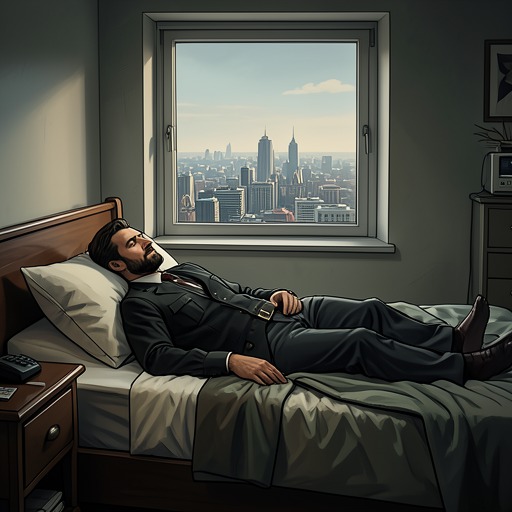
Danny and Peter entered the eternal sleep again
The Door into SummerDan Davis and Pete’s second Long Sleep is a deliberate, urgent departure from the present toward a promised reunion: Dan sells his car for immediate cash, forces a change to the awakening date, and enters cold sleep with Pete at his side. The scene reverses the helplessness of Dan’s earlier suspension. He now knows what he is choosing, insists on the terms, and is eager to reach the future where Ricky is waiting.
Background and Stakes
The second sleep follows Dan’s discovery that the financial arrangements meant to protect him have failed. The sanctuary’s custodial contract was separate from the contract for managing his estate; although the sanctuary’s fee had been paid in advance and placed in court escrow, Dan learned that Master Insurance had been looted and gone bankrupt. He had no assets and no longer owned the stocks he had expected to find intact. His body could be preserved, but the financial identity he had relied on had not survived the decades.
The legal framework makes that separation consequential. A cold-sleep client is alive but helpless and therefore legally in chancery, while the sanctuary holds custody under its own contract. Dan’s return to sleep is thus not simply a medical procedure: it depends on a new practical arrangement, cash in hand, and an exact awakening date he can accept.
Arranging the Return
At the village, Dan discovered that a helicopter bus would leave for the city in twenty-five minutes. He rushed to the only used-car lot and sold his car for half its value in exchange for immediate cash. With time barely left, he smuggled Pete onto the bus, since the service was strict about airsick cats, and reached Powell’s office shortly after eleven.
Powell objected that Dan had canceled his earlier arrangements with Mutual and lost his papers. He also protested that asking the same judge to approve another committal twice in twenty-four hours was irregular. Dan answered the objections with cash and made clear that he intended to enter cold sleep that day, even if he had to take his business elsewhere.
The awakening date was the point Dan would not yield. Powell wanted to add six months to the cold-sleep period and would not guarantee an exact date, explaining that contracts ordinarily allowed a one-month variation on either side for administrative hazards. Dan insisted instead on April 27, 2001, and told Powell he would go to another provider if Powell would not sell the arrangement he wanted. Powell changed the contract, and both men initialed it.
The Second Sleep
After an examination, the doctor remarked that Dan was in much better condition than the day before. Dan replied that the doctor did not know the half of it, then held and soothed Pete while the staff administered the cat’s first sedative. Dan lay back and let them work on him. He could have waited another day or longer, but he was frantically anxious to get back to 2001.
At about four in the afternoon, with Pete’s flat head resting on his chest, Dan happily went to sleep again. The physical detail gives the departure its intimacy: this time the companion who had been carried through the rush to the sanctuary is not left behind. Their shared descent into cold sleep is also framed by the specific date Dan has secured, making the future a scheduled destination rather than an indefinite hope.
Narrative Significance
The episode contrasts institutional failure with a small, hard-won measure of control. Master Insurance’s collapse has erased Dan’s assets, but it has not erased his ability to bargain over the next step. He cannot recover the investments or undo the lost decades; he can insist on an exact date, pay for the arrangement, and choose to leave immediately.
The second sleep also turns the story’s recurring passage through time toward reunion. Dan’s eagerness is directed not toward wealth or a restored past but toward returning to Ricky, while Pete’s warm weight against his chest anchors that temporal leap in companionship. The earlier cold-sleep arrangements had made Dan a helpless legal subject; here, even within the same vulnerable procedure, he enters on terms he has actively negotiated.